
Download
Development Team
For detail Installation Guide and Instruction read: Install Hackintosh High Sierra on PC/Laptop Features of Hackintosh High Sierra Installer: NO MBR Support, Only GUID Partitions will be able to Install (MBR can be patched manually) Fix for 'move Nvidia.pkg', 'move ATI.pkg', 'move Intel.pkg' issues.
- Windows*: Joe Olivas, Timo Kleimola, Mark Price, Timothy McKay
- MacOS*: Patrick Konsor
- Explore the world of Mac. Check out MacBook Pro, iMac Pro, MacBook Air, iMac, and more. Visit the Apple site to learn, buy, and get support.
- How to install Mac OS X Leopard on an intel PC designed for Windows XP. How to install Mac OS X Leopard on an intel PC designed for Windows XP.
- It's a free Mac app that creates an installer for macOS on a USB stick which is capable of being installed on an Intel PC. Mac Software, OS X, Note.
Previous Contributors
- Windows*: Seung-Woo Kim, Karthik Krishnan, Vardhan Dugar, Joseph Jin-Sung Lee, Jun De Vega
Introduction
Intel® Power Gadget is a software-based power usage monitoring tool enabled for Intel® Core™ processors (from 2nd Generation up to 10th Generation Intel® Core™ processors). Intel® Atom™ processors are not supported. It is supported on Windows* and macOS* and includes an application, driver, and libraries to monitor and estimate real-time processor package power information in watts using the energy counters in the processor. With this release, we are providing functionality to evaluate power information on various platforms including notebooks, desktops and servers. Windows 7* and 32-bit versions of the Intel® Power Gadget for Windows* has ceased development from 3.0.7. Starting with version 3.5 and going forward, only the 64-bit version and Windows 8* will be supported.
Background
Traditional methods to estimate power/energy usage of the processor has always been a cumbersome task that included special purpose tools or instrumentation on the platform along with third party equipment. The motivation for the tool was to assist end-users, ISV’s, OEM’s, developers, and others interested in a more precise estimation of power from a software level without any H/W instrumentation.
New Features
In version 3.0 there are additional features that include estimation of power on multi-socket systems as well as externally callable APIs to extract power information within sections of code. The multi-socket support essentially evaluates the Energy MSR on a per-socket basis and provides an estimate of power draw per socket. The API layer is a set of libraries and dlls that can be called and offers the flexibility to build the tool within code sections of an application. Latest release also includes support for Windows 10*.
Brief Description (Windows*)
Intel® Power Gadget 3.5 consists of the following components. Set of driver and libraries which access and post process the processor energy counter to calculate the power usage in Watts, temperate in Celsius and frequency in GHz (default install directory will be ~Program FilesIntelPower Gadget 3.5). A command line version of the tool (PowerLog3.0.exe) is also included
System Requirements (Windows*)
- Windows 8*
- Windows 10*
- Windows Server 2008, Windows Server 2012
- Microsoft .NET* Framework 4
- Microsoft Visual C++ 2017 Redistributable package
- 2nd Generation Intel® Core™ Processor or later, older processors not supported
- Single socket
- Multi-socket
System Requirements (MacOS*)
- macOS* 10.11 or later
- 2nd Generation Intel® Core™ processor or later
Known Limitations / Issues
- Graphs will not appear if your processor does not have the appropriate hardware counters
- Discrete graphics cards are not supported and GPU graphs will not appear unless Intel graphics is in use
- Windows 7* supported builds are below in the Archive section
Installation / Setup (Windows*)
- Run the msi package as an administrator. Accept the UAC, if one appears
- Follow the installer prompt instructions to complete installation
- .Net Framework 4 (will automatically be downloaded from Microsoft* site if not yet installed in your system) needs Internet connection
- Microsoft* Visual C++ 2017 Redistributable Package (will automatically get installed if not yet installed)
Installation / Setup (macOS*)
- Double click the downloaded DMG (Intel Power Gadget.dmg)
- Double click the package (Install Intel Power Gadget.pkg)
- Follow the installer prompt instructions to complete installation
On recent macOS versions, after installation users need to explicitly allow the Power Gadget driver to load:
- Open System Preferences, and click on 'Security and Privacy'
- Click the lock at the bottom of the page to unlock changes
- Click 'Allow' to allow system software from Intel Corporation:
- Restart your computer to apply the changes
On macOS Catalina (10.15), users may need to perform additional steps to enable the Power Gadget driver to automatically load (this is due to a bug in macOS).
- Open the Terminal application
- Enter the following command, and press Enter (requires a password to complete):
- Restart your computer to apply the changes
Usages (Windows*)
Common use of Intel® Power Gadget is to monitor energy usage of the processor
- Provides processor power (Watts), temperature (Celsius) and frequency (MHz) in real-time via graph displayed in the GUI
- Let you log the power and frequency measurements and save it in a csv format.
- Double click on the desktop shortcut and the GUI will launch
- Drag to move the GUI.
- Right click the GUI and a pop-up menu will show up allowing you to choose options or close the application. Options have the following parameters. Click “Start Log” button in the GUI to start logging. Press the same button “Stop Log” to stop logging. While it’s logging, red label “REC” will blink in the power chart area.
- You can choose to add time-stamp to the log file name or not.
- You can choose the log file name.
- You can choose to resize the GUI from 100% to 300% by dragging the slider and testing the new size with the “Apply Size” button and accept the changes by pressing “Ok”.
- Screen Update Resolution lets you change how often the GUI is updated at runtime. This may range from 50 ms to 1000 ms. (Default set to 1000 ms)
- Log Sampling Resolution lets you change the logging sampling resolution ranging from 1 ms to 1000 ms. (Default set to 100 ms)
- In a multi-socket system, you can choose which package information to display in the GUI. The log will record all package information in a csv file.
- Click 'Start Log' button in the GUI to start logging. Press the same button 'Stop Log' to stop logging. While it's logging, red label 'REC' will blink in the power chart area
Using Intel® Power Gadget 3.0 in a script
In order to start and stop the logging in a script, first launch the GUI as usual.
- At the beginning of the script, call 'IntelPowerGadget.exe -start' and it will trigger the logging in the GUI.
- At the end of the script, call “IntelPowerGadget.exe -stop” and it will stop the logging.
The parameters for the log are based on the options set in the GUI.
PowerLog3.0
PowerLog3.0.exe is the command line version of Intel® Power Gadget in logging power usage
Usage:
- Log power data to logfile for a period of time:
- Start a command a log power data to logfile until the command finish:
Logfile data
Logfile will include the elapsed timed, package power limit, processor frequency, GT frequency, processor temperature, average and cumulative power of the processor
- Processor Energy (Total energy of the processor) = IA Energy + GT Energy (if applicable) + Others (not measured)
- IA Energy (Energy of the CPU/processor cores)
- GT Energy (Energy of the processor graphics) – If applicable , some processors for desktops and servers don’t have it or may have use discrete graphics
Only works on 2nd Generation Intel® Core™ processor family or newer. Atom processors not yet supported.
Use only 32-bit installer for 32-bit OS and 64-bit installer for 64-bit OS
Application may hang after running for a long period of time (just close and restart application)
Contact your local Intel sales office or your distributor to obtain the latest specifications and before placing your product order.
This document contains information on products in the design phase of development.
All products, platforms, dates, and figures specified are preliminary based on current expectations, and are subject to change without notice. All dates specified are target dates, are provided for planning purposes only and are subject to change.
This document contains information on products in the design phase of development. Do not finalize a design with this information. Revised information will be published when the product is available. Verify with your local sales office that you have the latest datasheet before finalizing a design.
Code names featured are used internally within Intel to identify products that are in development and not yet publicly announced for release. Customers, licensees and other third parties are not authorized by Intel to use code names in advertising, promotion or marketing of any product or services and any such use of Intel's internal code names is at the sole risk of the user.
Intel and the Intel logo are trademarks of Intel Corporation in the U.S. and other countries.
*Other names and brands may be claimed as the property of others.
Copyright © 2019, Intel Corporation. All rights reserved.
Intel® Power Gadget also provides a C/C++ Application Programming Interface (API) for accessing this power and frequency data in your program; the API is supported on Windows and Mac OS X. For more information on the API's, see:
For Mac Using the Intel® Power Gadget API on Mac OS X
For Windows Using the Intel® Power Gadget API on Windows
End User License Agreement included in Windows* download
Notices
INFORMATION IN THIS DOCUMENT IS PROVIDED IN CONNECTION WITH INTEL® PRODUCTS. NO LICENSE, EXPRESS OR IMPLIED, BY ESTOPPEL OR OTHERWISE, TO ANY INTELLECTUAL PROPERTY RIGHTS IS GRANTED BY THIS DOCUMENT. EXCEPT AS PROVIDED IN INTEL'S TERMS AND CONDITIONS OF SALE FOR SUCH PRODUCTS, INTEL ASSUMES NO LIABILITY WHATSOEVER, AND INTEL DISCLAIMS ANY EXPRESS OR IMPLIED WARRANTY, RELATING TO SALE AND/OR USE OF INTEL PRODUCTS INCLUDING LIABILITY OR WARRANTIES RELATING TO FITNESS FOR A PARTICULAR PURPOSE, MERCHANTABILITY, OR INFRINGEMENT OF ANY PATENT, COPYRIGHT OR OTHER INTELLECTUAL PROPERTY RIGHT.
UNLESS OTHERWISE AGREED IN WRITING BY INTEL, THE INTEL PRODUCTS ARE NOT DESIGNED NOR INTENDED FOR ANY APPLICATION IN WHICH THE FAILURE OF THE INTEL PRODUCT COULD CREATE A SITUATION WHERE PERSONAL INJURY OR DEATH MAY OCCUR.
Intel may make changes to specifications and product descriptions at any time, without notice. Designers must not rely on the absence or characteristics of any features or instructions marked 'reserved' or 'undefined.' Intel reserves these for future definition and shall have no responsibility whatsoever for conflicts or incompatibilities arising from future changes to them. The information here is subject to change without notice. Do not finalize a design with this information.
The products described in this document may contain design defects or errors known as errata which may cause the product to deviate from published specifications. Current characterized errata are available on request.
iBoot + MultiBeast: Install Mac OS X on any Intel-based PC
iBoot and MultiBeast Install Mac OS X on any Intel-based PC
iBoot and MultiBeast Install Mac OS X on Intel-based PC
this article have been copied from this source
Any OSx86 installation guide can seem daunting at first glance, especially when trying to remember cryptic terminal commands and sorting through volumes of misinformation on the web. This guide requires no coding, terminal work, or Mac experience of any kind. You will not need access to a Mac. In fact, it’s easier and faster for me to install Snow Leopard with fully working components on my system than it is to install Windows 7. And more fun.
The iBoot + MultiBeast method is designed and tested for any desktop or laptop running the latest line of Intel processors, the Core i3/i5/i7s. I have had reports of success with older machines as well including CoreDuo, Core2Duo, and even Pentium 4. However, AMD processors are not supported.
YOU WILL NEED
- A computer running an Intel Processor
- A blank CD
- A Mac OS X Snow Leopard Retail DVD
- To leave any fear of your computer at the door.
- Patience and humility- it may not work out perfectly the first time- but with enough tenacity and grit, you’ll reach the promised land. It’s easy to get frustrated, but don’t give up! There are a community of users with similar hardware in the tonymacx86 Forum to provide support if you get stuck.
BEFORE YOU BEGIN
- Use only 1 graphics card in the 1st PCIe slot with 1 monitor plugged in.
- Remove any hard drives besides the blank drive being used for OS X.
- Remove any USB peripherals besides keyboard and mouse.
- Remove any PCI cards besides graphics- they may not be Mac compatible.
- It’s best to use an empty hard drive– you will have to partition and format the drive.
- Always back up any of your important data.
STEP 1: BIOS SETTINGS
You will need to set your BIOS to ACHI mode and your Boot Priority to boot from CD-ROM first. This is the most important step, and one many people overlook. Make sure your bios settings match these. It’s not difficult- the only thing I did on my Gigabyte board besides setting Boot Priority to CD/DVD first was set Optimized Defaults, change SATA to AHCI mode, and set HPET to 64-bit mode.
STEP 2: INSTALL MAC OS X
In order to boot the Mac OS X Retail DVD, you’ll need to download and burniBoot. For desktops and laptops using unsupported Intel CPUs and graphics, a legacy version of iBoot can be downloaded here. If you have an Ivy Bridge or Haswell system, you can’t use the default iBoot. Use iBoot Ivy Bridge or iBoot Haswell.
- Download iBoot
- Burn the image to CD
- Place iBoot in CD/DVD drive
- Restart computer
- At boot prompt, eject iBoot
- Insert your Mac OS X Snow Leopard Retail DVD and press F5
- When you see the screen below, press enter to begin the boot process
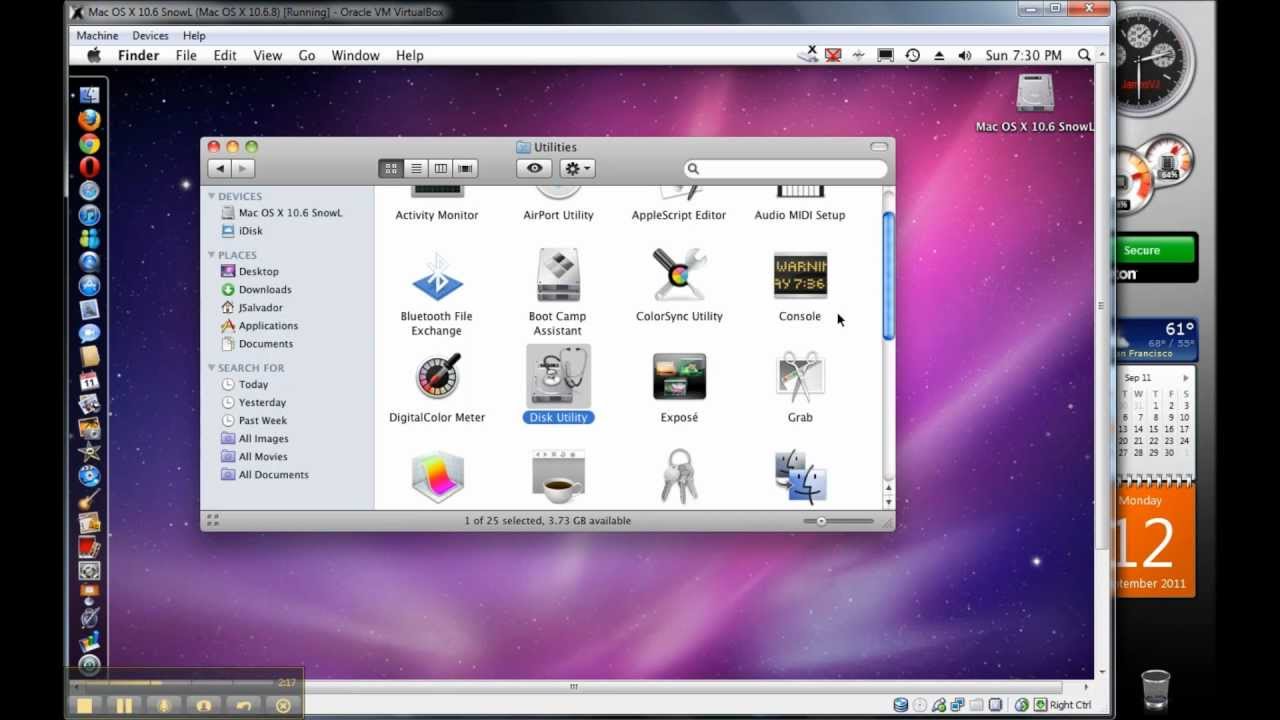
- When you get to the installation screen, open Utilities/Disk Utility. NOTE: If you cannot get to the installation screen, retry from Step 4, type PCIRootUID=1 before hitting enter. If that doesn’t work then try PCIRootUID=1 -x or just -x which will enter Mac OS X Safe Mode and will allow you to proceed. For some graphics cards, use GraphicsEnabler=No boot flag to proceed.
- Partition your hard drive to GUID Partition Table
- Format your hard drive to Mac OS Extended (Journaled). NOTE: The bootloader can only boot from a disk or partition of 1 TB or less. Partition larger drives.
- For the purposes of this guide, name it Snow Leopard. You can rename it later.
- Close Disk Utility
- When the installer asks you where to install, choose Snow Leopard
- Choose Customize‚ and uncheck additional options. This will hasten the install process. You can always install this stuff later.
- Restart computer.
- Place iBoot back in drive.
- When you get to the boot selection screen, choose your new Snow Leopard installation.
- View the super-cool Mac OS X Snow Leopard Welcome Video, and set up your computer!
STEP 3: UPDATE TO 10.6.8
If you have a Sandy Bridge system, please follow these specialized instructions to update to 10.6.8.
- Open Finder and navigate to your Snow Leopard drive.
- Download the Mac OS X 10.6.8 Combo Update
- Download MultiBeast
- Open MultiBeast– don’t run it yet, just leave it open. Set up windows as shown.
- Mount MacOSXUpdCombo10.6.8.dmg
- Install MacOSXUpdCombo10.6.8.pkg
- Upon completion, the installer will ask you to reboot. DO NOT REBOOT.
- Switch to the already open MultiBeast. If it closes, just re-open it.
STEP 4: MULTIBEAST
How To Install Mac Os On Pc
MultiBeast is an all-in-one post-installation tool designed to enable boot from hard drive, and install support for Audio, Network, and Graphics. It contains two different complete post-installation solutions: EasyBeast and UserDSDT. In addition it includes System Utilities to rebuild caches and repair permissions and a collection of drivers, boot loaders, boot time config files and handy software.
Choose one of the following options directly following a fresh installation and update:
EasyBeast is a DSDT-free solution for any Core/Core2/Core i system. It installs all of the essentials to allow your system to boot from the hard drive. Audio, Graphics and Network will have to be enabled separately.
UserDSDT is a bare-minimum solution for those who have their own pre-edited DSDT. Place your DSDT.aml on the desktop before install. Audio, Graphics and Network will have to be enabled separately. HINT: Check the DSDT Database for a pre-edited DSDT.
- Run MultiBeast.
- If you have a custom DSDT that’s been edited, place the file on your desktop and choose UserDSDT.
- All others select EasyBeast
- Select System Utilities.
- Optionally, you may install further drivers via Advanced Options to enable ethernet, sound, graphics, etc… Be sure to read the documentation provided about each installation option. NOTE:EasyBeast, and UserDSDT install the bootloader by default, so you’ll not need to check that option.
- Install to Snow Leopard– it should take about 4 minutes to run scripts.
- Eject iBoot.
- Reboot- from your new Snow Leopard installation drive.
Congratulations! You’re done!!
Your PC is now fully operational, while running the latest version of Mac OS X Snow Leopard! And you have a nice Boot CD to get into your system in case things go awry. Boot your system from iBoot if you have issues. You may run MultiBeast as often as you like.
Mac Os X Lion For Intel Pc
If you can’t boot, try typing -x at the boot prompt to enter safe mode, or just boot with iBoot. When you get to the desktop, you can make all of the changes you need to. The best way to start fresh is delete whatever you’re trying to get rid of- including the whole /Extra folder, as most kexts are installed there. Then you can re-run MultiBeast. As long as you rebuild caches and repair permissions after you’re done, you can do just about anything you want to /Extra/Extensions and /System/Library/Extensions. Anything can be tweaked and enabled upon subsequent uses of MultiBeast.
If you’ve had success using iBoot + MultiBeast, consider a contribution to help keep the sites going. We’re constantly updating and tweaking our tools to help you.
Mac Os X For Intel Pc Processor
Thanks in advance!
-tonymacx86 & MacMan
For our most current workarounds and solutions forissues such as USB and audio, check out the Mac OS X 10.6.3 Update, Mac OS X 10.6.4 Update,Mac OS X 10.6.5 Update, Mac OS X 10.6.6 Update, Mac OS X 10.6.7 Update, and Mac OS X 10.6.8 Updatearticles. Good luck, and see you on the forum!