
Home > Articles > Cisco > CCNA Routing and Switching
Use this method to obtain the MAC Address of your local computer as well as query remotely by computer name or IP Address. Hold down the “Windows Key” and press “R“. Type “CMD“, then press “Enter“. You can use one of the following commands: GETMAC /s computername – Get MAC Address remotely by Computer Name.
␡- MAC Address Tables
- Proceeding from Example of the address table, press S (for S earch), to display the following prompt: Enter MAC address: Enter the MAC address you want to locate and press Enter. The address and port number are highlighted if found (Example of menu indicating located MAC address.) If the switch does not find the MAC address on the.
- We can find mac address (physical address) of a computer using the command ‘getmac‘. This can be used to get mac address for remote computers also. Below are few examples on how to use this command. It works on XP, Vista, Windows 7, Server 2003 and Server 2008 operating systems. Get mac addresses from CMD.
- Show mac-address-table port. Displays the mac-address-table for specified ports. Show mac-address-table port Default.
- Oct 15, 2019 Here are the commands to show the mac address table on a MikroTik Router. In addition to using the command line to show the mac address table, this tutorial I will also show you how to search for a specific MAC address and filter the table to show mac addresses learned through a specific port.
Like this article? We recommend
Like this article? We recommend
Cisco Show Mac Address Table
MAC Address Tables
A MAC address table, sometimes called a Content Addressable Memory (CAM) table, is used on Ethernet switches to determine where to forward traffic on a LAN. Now let's break this down a little bit to understand how the MAC address table is built and used by an Ethernet switch to help traffic move along the path to its destination. We will use the graphic in Figure 1.
In Figure 1, a switch is surrounded by a number of common devices. Let's assume that all of the devices are powered on but have not sent any traffic. In this case, the MAC address table of the switch would be empty (ignoring any system MAC addresses shown in the table by default).
Now suppose PC1 wants to send traffic to the server that has a MAC address of 00:00:00:00:00:01. It would encapsulate an Ethernet frame and send it off toward the switch. The first thing the switch would do when receiving the traffic is create a new entry in its MAC address table for PC1's MAC address (PC1 -> Fa0/3). The switch would then perform a lookup on its MAC address table to determine whether it knows which port to send the traffic to; since no matching entries exist in the switch's tables, it would flood the frame out all of its interfaces (except the receiving port).
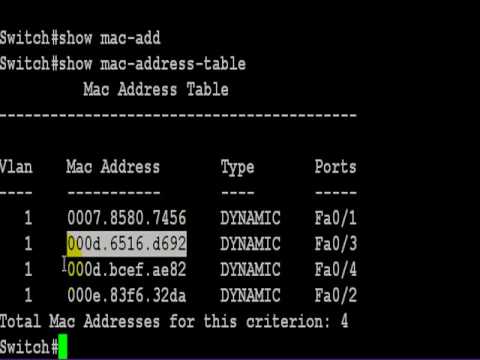
Because the frame was sent out to all of the switch's other ports, it would be received by the target server. Assuming that the server wants to respond to PC1, it would sent a new frame back toward the switch. The switch would receive the frame and create a new entry in its MAC address table for the server's MAC address (Server -> Fa0/2). It would then perform a lookup of its MAC address table to determine whether it knows which port to send the server's traffic to; in this case it does, so it sends the return traffic out only its Fa0/3 port (PC1), without flooding. Listing 1 shows what the MAC address table would look like at this point.
Listing 1—MAC address table example.
Understanding Mac Address
This process repeats as devices continue to send traffic to each other. An important detail to remember is that the MAC address table timeout is typically short (Cisco's default is five minutes), so an entry is left in the table itself only for that specified amount of time before the timeout expires and the entry is removed from the table.
Now we will move on to the question of how the devices get the destination MAC addresses to begin this process; in a word, ARP.
Related Resources
Cisco Command Mac Address Table
- Book $55.99
- Book $55.99
- Premium Edition eBook $55.99